

Rethinking How We Work Is the New Challenge


Artificial intelligence is changing something more fundamental than how quickly we complete a task. It is beginning to reshape how work is organized: what people do, what systems can handle, which decisions require human involvement, and how the different stages of a process connect.
That is why the challenge is no longer just about automation. It is about questioning whether the way we work still makes sense now that new capabilities are available.
For years, automation meant identifying repetitive tasks and finding ways to execute them without human intervention. A form could trigger an email, a purchase could update a record, or a new contact could automatically enter a database. The logic was straightforward: if A happens, do B.
Artificial intelligence is introducing a different approach. We can now define an objective and allow a system to determine which steps are needed to achieve it, which tools to use, and when human intervention is required.
The question is no longer simply what we can automate. It becomes: How should this process work if we could redesign it from the ground up with AI?
Designing Processes with AI: The Challenge Is How We Work
Automating a task can save time.
Redesigning a process can change how an organization operates.
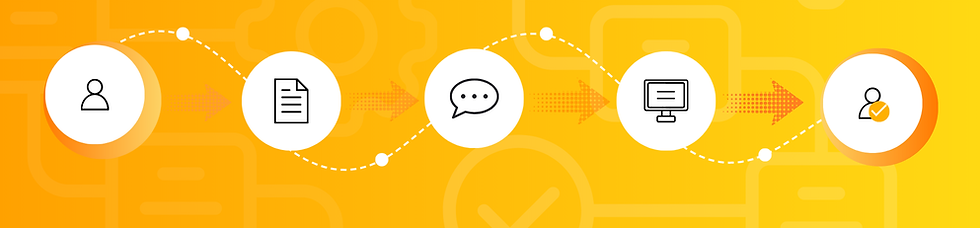
Consider a straightforward sales process. Someone fills out a form; a team member receives the inquiry, reviews the information, responds, schedules a meeting, prepares a proposal, and follows up. Some of these steps can be automated, but the process is still treated as a sequence of human tasks with automation added along the way.
With AI agents, the approach can be different. A system can interpret an inquiry, identify the type of opportunity it represents, find relevant information, prepare a response, suggest a meeting, and update records. Instead of adding automation to an existing process, we can begin designing AI-driven processes around the outcome we want to achieve.
The goal is not to replace every task, but to rethink the entire workflow.
This distinction matters because the benefits of AI do not appear to translate equally into individual productivity and business results.
A McKinsey study published in September 2026 found that 80% of respondents reported improvements in individual productivity from AI, while only 37% attributed some impact on their organization's EBIT to it. The difference points to a central issue: working faster does not necessarily mean the business is performing better. Read the McKinsey analysis on how agentic AI can reshape workflows.
The challenge often lies in coordination: handoffs between people and teams, waiting times, information moving from one tool to another, and decisions that require context. Individually, these may seem like minor inefficiencies, but together they can account for a significant share of operational costs.
When the Unit of Work Is No Longer a Task
An AI assistant responds; an AI agent can take action. When several agents work together, the unit of work starts to look less like an individual task and more like an entire process.
This is one of the ideas behind the evolution of agentic AI: systems that can interpret objectives, plan actions, use tools, and execute multiple steps with a degree of autonomy.
The difference between a traditional chatbot and an AI agent is not simply that the latter can do more things. It is that an agent can participate in a workflow. A marketing agent might identify an opportunity, research relevant information, prepare a campaign, and submit it for approval. A customer service agent might identify an inquiry, classify it, retrieve relevant background information, and prepare a response. Another agent could analyze financial data, detect an unusual pattern, and generate an alert.
The real value lies not in each agent individually, but in how they connect and what they can accomplish when they coordinate their work.
A Real-World Example of Where This Is Heading
Wix Symphony is a useful example of this shift, although the broader trend extends far beyond Wix.
Symphony is presented as an AI agent platform that brings together specialized agents and coordinates them through an orchestrator. These agents can connect with tools a business already uses and work across different parts of its operations. Explore Wix Symphony.

The interesting part is how this changes the interface. Instead of opening different applications to perform individual tasks, a person can describe a need in a conversation and let an orchestrator distribute the work among specialized agents.
For example, a business might say: “We need to follow up on the inquiries that were left unanswered this week.”
That is no longer a single task. It is an objective.
In Symphony, this approach is built around an orchestrator called Maestro, which receives the objective, coordinates the appropriate agents, and allows users to supervise the work. Wix's Symphony documentation explains how users can provide an objective and let Maestro assign work to the relevant agents.
The agents can also work in the background and execute multistep tasks, while actions that require human involvement remain subject to approval. Learn more in the Wix Help Center's overview of Symphony AI credits.
This is where the conversation moves beyond assistants and into operational infrastructure.

The Real Challenge Is Not Implementing AI
It is understanding which processes are worth transforming.
A company can introduce five AI tools and continue working exactly as it did before. It can also automate twenty tasks and end up with twenty disconnected automations.
Technology alone does not fix a disorganized process. In fact, it can amplify the existing problems.
If a company does not know who should make a decision, what information that person needs, or what should happen next, adding AI will not necessarily solve the problem.
The important question, then, is not just which processes we can automate, but which parts of the way we currently work deserve to be reconsidered.
That is why it helps to examine the entire workflow: what initiates it, what information comes in, where delays occur, which tasks are repeated, where information is copied between tools, and which decisions require human judgment.
It is also necessary to determine what can be delegated, when a person should step in, and what should happen after each decision.
These questions may seem operational, but they have strategic implications. Designing AI-driven processes forces a company to make explicit how its work actually gets done.

AI Is Also Changing How Organizations Work
This shift affects more than technology. It also changes people's roles.
When someone spends less time gathering information, copying data, or manually following up, their work can shift toward supervision, analysis, and decision-making. This requires new capabilities, although not necessarily programming skills. Understanding processes, data, context, approval criteria, and the limits of AI autonomy becomes increasingly important.
IThe potential impact is particularly relevant in Latin America. A McKinsey study published in July 2026 estimates that more than half of the region's current working hours could technically be automated using existing AI and other technologies. The same analysis estimates an economic potential of approximately US$450 billion annually by 2030, while noting that this is a technical feasibility estimate and that its realization will depend on factors such as adoption and organizational readiness. Read McKinsey's analysis of how AI is reshaping work and skills in Latin America.
That last point may be the most important: the technology may be available, but organizations need to be prepared to use it effectively.
Design Before You Automate
An idea gaining traction in this new phase is that AI-first does not mean putting AI everywhere.
It means questioning whether the current process still makes sense.

Sometimes the answer will be to automate a task. In other cases, it may mean integrating two tools or eliminating a step that no longer adds value. Some processes may require an entirely new way of working, with different roles for people and AI agents.
This connects with a broader shift in how we think about digital ecosystems.
In an earlier article, we explored how a website can become more than an isolated asset and serve as the hub of your digital ecosystem. We also examined how connecting tools and actions helps build a digital ecosystem that works, rather than accumulating channels and tools that operate independently.
AI takes that same logic a step further. The goal is no longer simply to connect systems, but to enable some of those systems to understand what is happening and act accordingly.
That changes the conversation about automation.
The New Map of Work
For a long time, we thought of digital transformation as an accumulation of tools: a website, a CRM, an email platform, a payment system, an analytics tool, and various automations.
Now a different possibility is emerging: these components can become part of a coordinated process, with AI agents operating across them.
The result should not be a company with more technology, but one with less friction: less duplicated information, fewer manual tasks, fewer delays between teams, and fewer processes that depend on someone remembering to do something.
This can free up time for work that genuinely requires judgment, creativity, business knowledge, and human relationships.
That is why the next challenge of AI may not be learning to use more tools. It may be learning to rethink how we work.
The question is no longer just what tasks artificial intelligence can perform for us. It is what we would change about the way we work if we could redesign our processes with a clear understanding of what AI can do today.
Perhaps the most important transformation will not happen when a company adopts a new tool, but when it dares to question a process that has worked the same way for years.


